The Six Nights Around a Vaccination
Fifteen minutes of settling, run every night for the short window either side of a shot. The thing with the data behind it is the sleep this protects, not the practice itself.
Why it works
Sleep is one of the few behaviours with a measured line running to how well a vaccine takes. In the one experiment that cut it deliberately around the day of an injection, the antibody response came back smaller. The proposed route is the ordinary overnight biology that governs the rest of adaptive immunity: slow-wave sleep is when the nocturnal fall in cortisol and catecholamines meets the rise in growth hormone and prolactin, and that combination favours the T-cell work that turns an injected antigen into memory. Short sleep runs sympathetic tone and evening cortisol higher, which pushes the other way. So why is this a meditation entry and not a line of sleep advice. Because the reason people lose sleep in the days around an appointment is rarely that they went to bed late. It is lying in the dark with the mind running. A settling practice is the part of this a person can do at eleven at night, and mindfulness training has small trials of its own showing it improves how people rate their sleep. Keep the two links apart in your head, because nobody has joined them. Link one: meditation improves reported sleep, modestly, in small samples. Link two: measured sleep tracks vaccine antibody response and susceptibility to a cold virus. No trial has run people through meditation, longer sleep, and a bigger antibody response in one piece of work. That study does not exist, and this entry is not a prediction of how it would come out.
The sleep-and-vaccine link rests on one small experiment and larger observational work pointing the same way. Spiegel, Sheridan and Van Cauter (JAMA, 2002) restricted 11 of 25 healthy young men to four hours in bed for six nights around an influenza vaccination, and their antibody titres ten days later came in at less than half those of the 14 who slept normally. By three to four weeks the difference was no longer significant, which reads as a slower response rather than a permanently smaller one. Prather and colleagues (Sleep, 2012) followed 125 adults through a three-dose hepatitis B course with sleep recorded by wrist actigraphy rather than asked about, and shorter sleep predicted a lower antibody response and a greater chance of being left below the protective threshold at six months. The same group (Sleep, 2015) measured a week of sleep in 164 adults, then gave all of them rhinovirus under quarantine: those sleeping six hours or less were roughly four times more likely to develop a cold than those sleeping more than seven. The meditation link is thinner than any of that. Black and colleagues (JAMA Internal Medicine, 2015) randomised 49 older adults with moderate sleep disturbance to six weeks of mindfulness practice or to a matched sleep-hygiene course, and the mindfulness arm improved more on a sleep-quality questionnaire. Forty-nine people, a self-reported outcome, six weeks. What is missing is the join. The vaccine studies manipulated or measured sleep, never meditation. The meditation study measured sleep, never antibody. Spiegel's sample was 25 young men and the restriction was severe, which is a different thing from one ragged night. The 2012 and 2015 studies are observational on the sleep side, so short sleepers differ from long sleepers in ways beyond their sleep. None of this says a practice will change how a vaccination goes for you.
How to practice
- Decide the window before the appointment rather than after it. The four nights before, the night of the appointment, and the one after: that is the span the restriction study covered, six nights with the injection given partway through, and a week you have noticed in advance is easier to protect than one you are already inside.
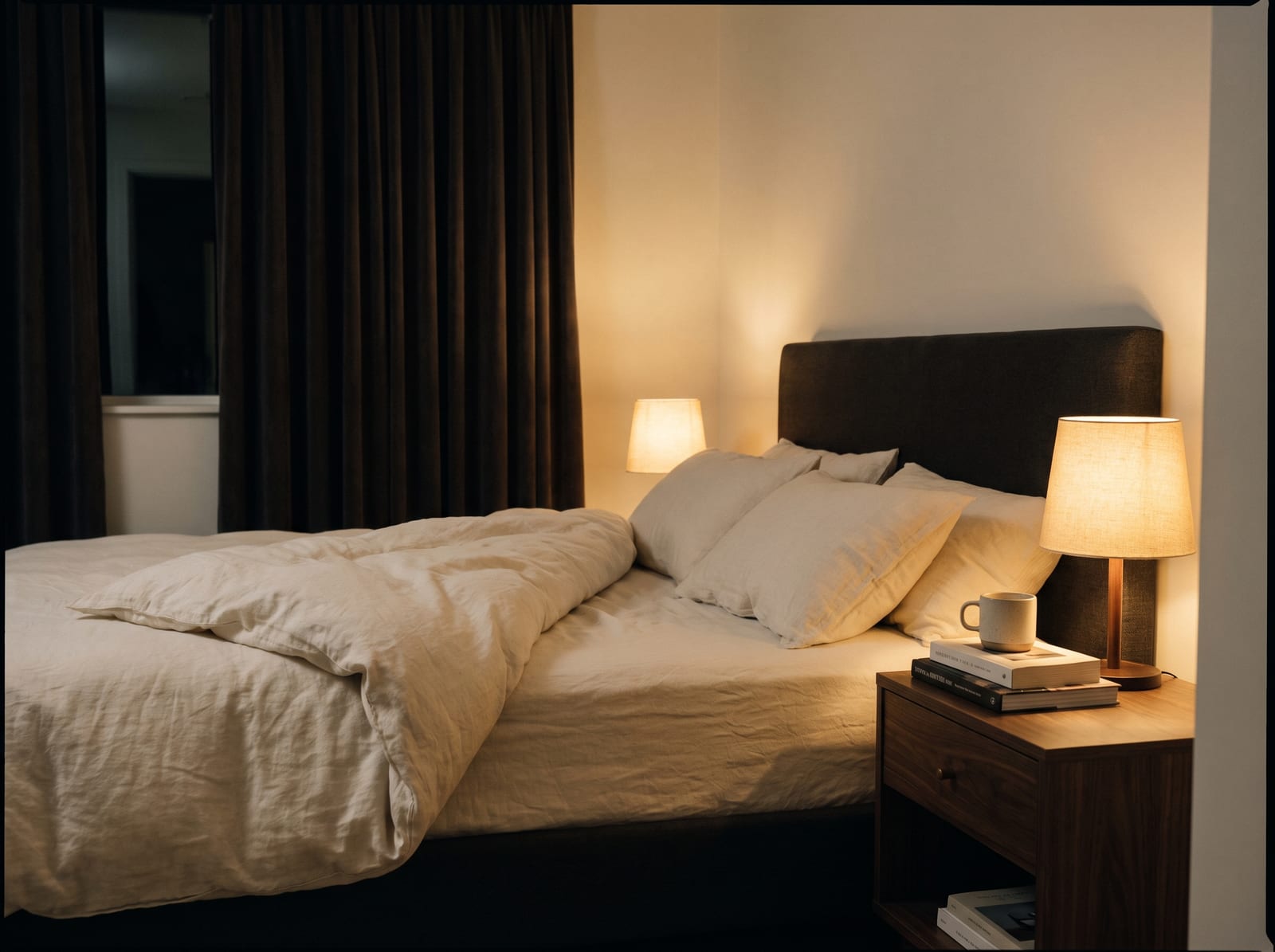
- Work backwards fifteen minutes from the time you mean to be asleep, and put the practice in that gap. It goes before lights out, not on top of it.
- Lie on your back where you are going to sleep, lights off or nearly, arms a little away from your sides.
- Give the first two minutes to the out-breath alone. Let the in-breath arrive on its own and make each exhale a little longer than it wants to be. Count six of them, then stop counting.
- Take one slow pass through the body: feet, legs, hips, low back, hands, arms, jaw, forehead. A few seconds each, finding what is there instead of trying to loosen it.
- When the appointment or the day comes up, name it in three or four words and leave it at that. The thought arriving is not the problem. Being carried off by it for ten minutes is.
- Come back to whichever is easier to find: the weight of the body on the mattress, or the end of the out-breath.
- If you are still awake when the fifteen minutes are up, stop practising and let the night be a night. Lying there working at sleep is how one poor night becomes four.
- Keep the same window on the night after, even if you feel fine. The response to an injection unfolds over the following days rather than the following hour.
- The practice is not the intervention. The hours of sleep it protects are the part with measurements attached.
- More time asleep is something you can aim at. Deeper sleep is not.
- One short night is not what the study did. Those men were held to four hours for six nights running.
- This is no reason to put off a vaccination, and no reason to expect less of one you slept badly before.
⚠ Nothing here changes whether a vaccine works for you and nothing here treats an infection. Take the appointment whenever you can get it; a bad night is not a reason to postpone one. Sustained attention on the body raises distress rather than lowering it for some people, which is more likely after trauma, so open your eyes and stop if that happens. Sleep broken most nights for weeks, loud snoring with daytime sleepiness, or waking unrefreshed no matter how long you were in bed are reasons to see a clinician rather than to practise harder.