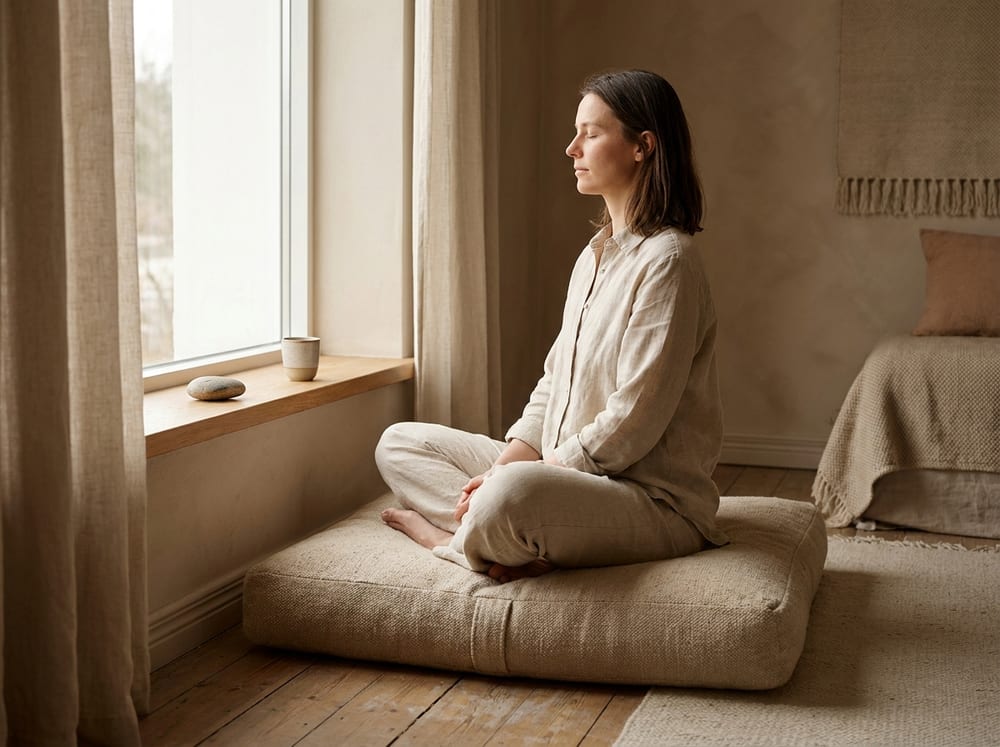
Open-Monitoring Meditation for Stress Relief
Rest in wide-open awareness. Let sounds, sensations, and thoughts arise and pass without grabbing at them or pushing any of them away.
Why it works
Open-monitoring trains non-reactive awareness, so stressful thoughts get observed as passing events instead of five-alarm emergencies, which dampens sympathetic reactivity and the cortisol response that follows it. Decoupling from automatic rumination strengthens prefrontal regulation of the amygdala, and the relaxed, alert baseline this builds supports lower stress and clearer thinking, both at once.
Open-monitoring practice is associated with reduced amygdala reactivity, lower cortisol, and improved emotion regulation and cognitive flexibility. That's a lot of return for sitting still and doing, technically, nothing.
- Tone
- 396 Hz. Root, in the chakra tone ladder, which is lineage rather than physiology.
How to practice
- Sit upright and alert, take a few slow breaths, then let the breath settle into its own rhythm.
- Begin with a brief anchor on the breath for about a minute to settle attention.
- Widen your awareness to include whatever is most prominent: a sound, a body sensation, an emotion, a thought.
- Simply note each experience as it arises (for example, hearing, aching, thinking) and let it pass on its own.
- Do not follow, analyze, or resist any experience; rest as the open space in which they come and go.
- If you get pulled into a story, gently return to the breath for a breath or two, then reopen awareness.
- After about 10 minutes, narrow back down to the breath, then open your eyes.
- Be the sky, not the weather passing through it. You were never the storm.
- Noting a thought as 'thinking' is enough. No need to unpack its whole suitcase.
- Stay alert and relaxed at once. Neither straining nor drifting off to sleep.
⚠ If unsettling thoughts or emotions become overwhelming, return to the breath anchor or stop; those with trauma histories may prefer a guided or teacher-supported version.