Rear-Foot-Elevated Split Squat
A single-leg squat with your back foot kicked up on a chair behind you, which piles almost your whole bodyweight onto the front leg and makes bodyweight training work again.
Why it works
Here's the problem with training legs at home: two-legged squats stop being hard long before your legs stop needing the work. Prop one foot behind you on a chair and suddenly nearly all your bodyweight lands on the front leg, so an ordinary squat gets genuinely difficult again without you needing a barbell. It also trains each leg on its own, which matters more than people think, because leg strength imbalance is common after almost any injury and hides in plain sight during two-legged moves. That elevated back leg also stretches the hip flexor on that side under real load, which anyone who sits at a desk all day badly needs. Fair warning: this one is humbling the first time, even for someone who finds two-legged squats easy.
How to do it
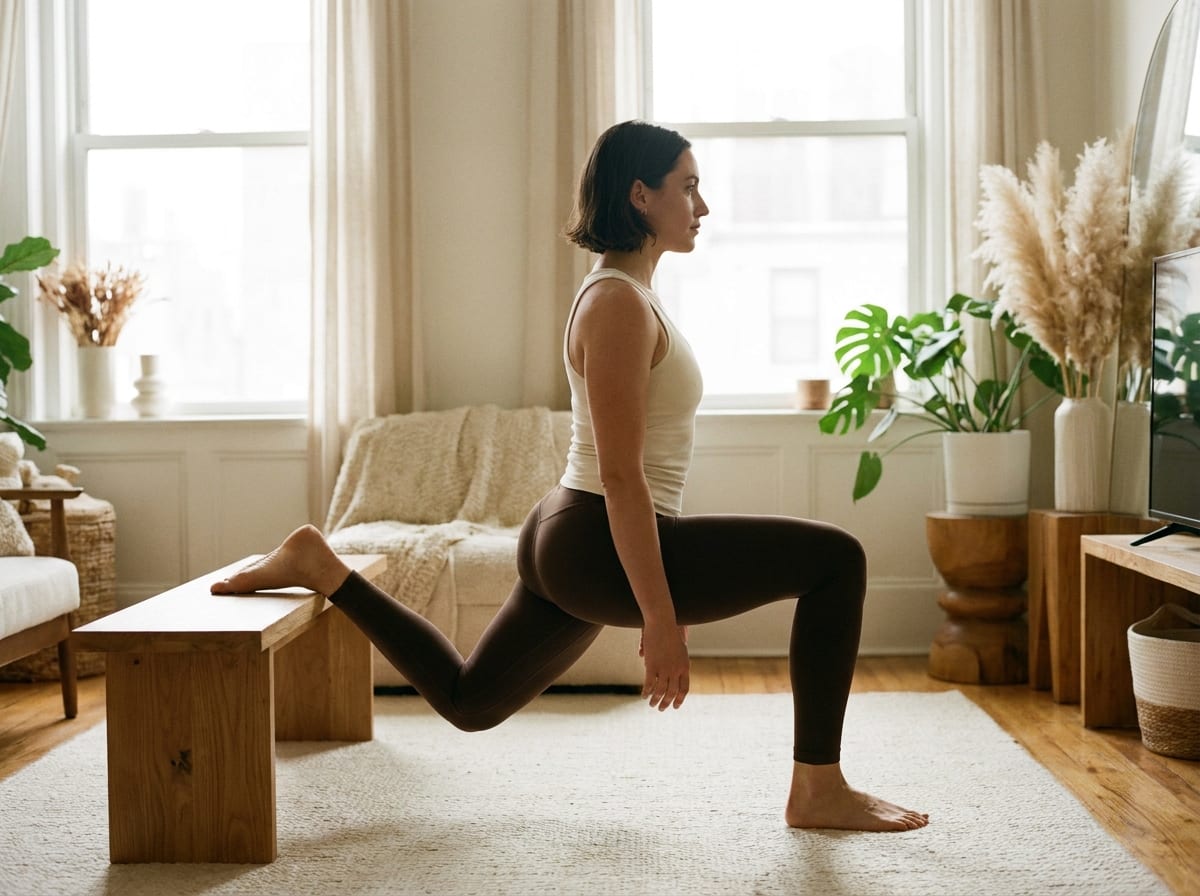
- Stand about two feet in front of a chair and place the top of one foot on the seat behind you.
- Check the distance: at the bottom of the movement your front shin should be roughly vertical, so adjust before you load it.
- Lower straight down by bending the front knee, letting the back knee travel toward the floor, keeping your torso mostly upright.
- Stop when your front thigh is parallel to the floor or when your range runs out, then drive up through the front heel.
- Complete all repetitions on one side before switching. Hold a wall or counter with one hand if balance is the limiting factor rather than strength.
Dose: 3 sets of 6 to 12 repetitions per leg, 2 times a week. Both legs get the same number, the weaker one doesn't get a pass.
⚠ This is educational content for discussion with a clinician, not medical advice or a prescription. Reduce the depth with knee pain at the front of the joint. Put a folded towel under the rear foot if the top of that foot or ankle is uncomfortable. Use support for balance rather than skipping it.