Cat-Cow Spinal Flow
A slow, breath-paced wave of flexion and extension through your whole spine, on hands and knees, one vertebra moving at a time.
Why it works
Cat-Cow doesn't move your spine as one stiff block. It moves it segment by segment, one vertebra at a time, which is the whole point. That segmental motion is what feeds your intervertebral discs: they have no direct blood supply of their own, so they depend entirely on this pumping action to trade fluid and nutrients in and out, a mechanism that quietly declines with age and with too many hours sitting still. Along the way it mobilizes the facet joints in your lumbar and thoracic spine and gently loads the erector spinae and abdominals through their full length. Keep that segmental motion alive now, and later in life it decides whether tying your shoes, getting up off the floor, and reaching for a top shelf stay easy, or turn into a hostile negotiation with your own spine.
How to do it
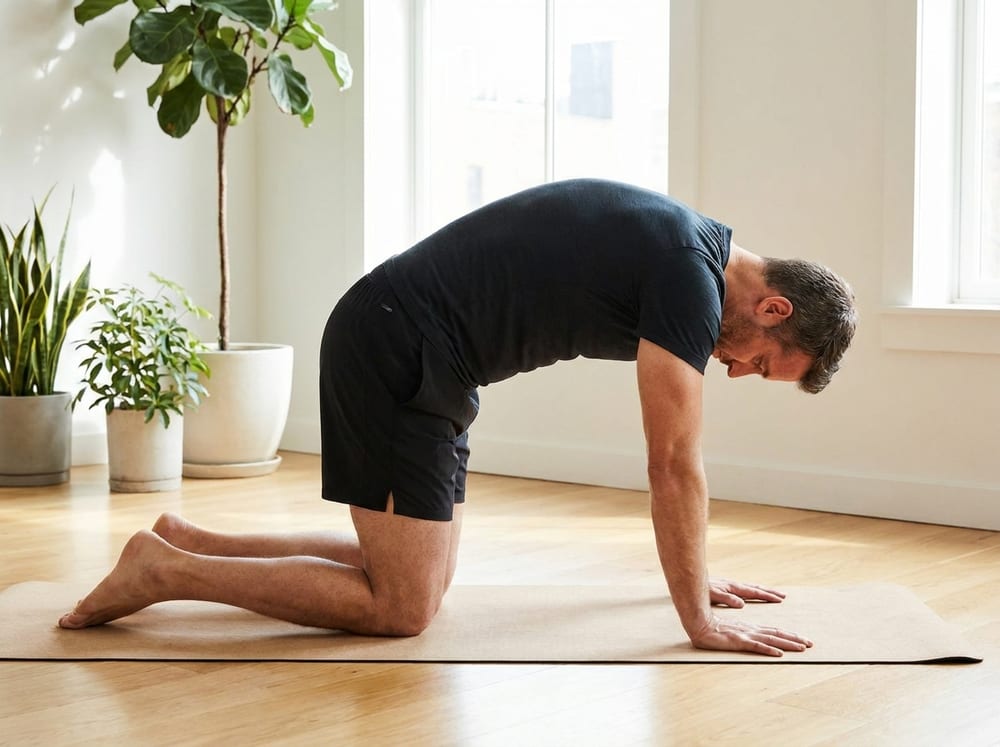
- Start on hands and knees with wrists under shoulders and knees under hips, spine in a neutral flat position.
- Inhale and drop your belly, lifting your chest and tailbone toward the ceiling as your gaze rises slightly (cow).
- Exhale and reverse: round your back toward the ceiling, tuck your chin and tailbone, pushing the floor away (cat).
- Move one vertebra at a time, letting your breath set a slow, even pace.
- Flow smoothly between the two positions without holding tension in the neck or shoulders.
Dose: 2 sets of 10 slow cycles, daily. Slow means slow, not a race to the cool-down.
⚠ If your wrists are sensitive, make fists or place a rolled towel under the heels of your hands. Keep the neck motion gentle and follow the spine rather than cranking the head back. Ease the range if you have acute back pain.