Shoulder Controlled Rotations
A slow, deliberate circle of your arm through your shoulder's full available range, one side at a time, taking about twenty seconds per rotation. No momentum allowed.
Why it works
Your shoulder has more range than any other joint in your body, and it loses that range faster than almost anything else, because ordinary life asks almost nothing of it at the ends of that range. Nobody's reaching overhead and behind themselves repeatedly on a normal Tuesday. Moving the joint slowly and deliberately through its whole circle, under your own control instead of swung by momentum, is how you keep the range you've still got and claw back what's already gone. The slowness is not incidental, it is the entire active ingredient: fast arm circles get carried by momentum straight through exactly the positions where your control is weakest, which are precisely the positions worth training in the first place. Expect to find catches and sticky spots along the way, and expect them to show up differently on each side.
How to do it
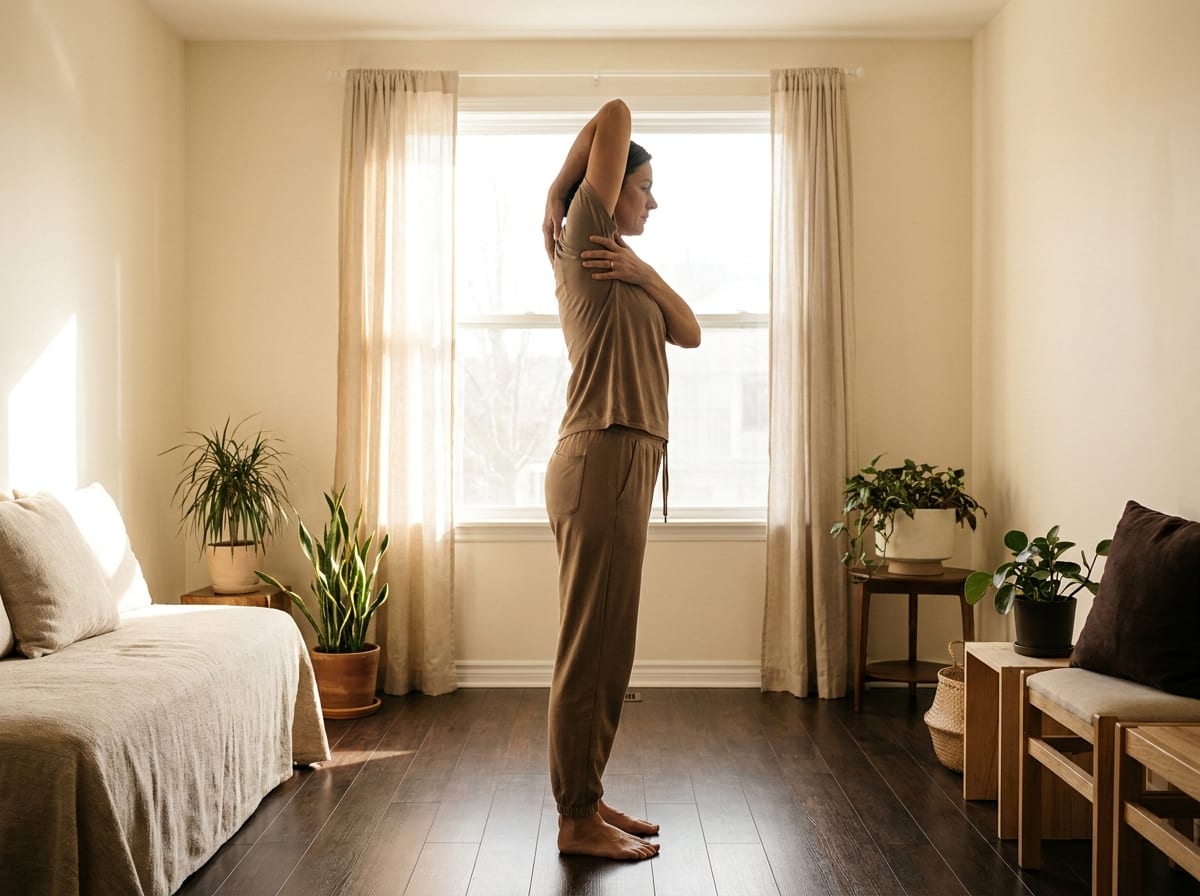
- Stand tall and place your free hand on the opposite shoulder so you can feel whether it stays put.
- Raise one arm in front of you as high as it will go, keeping your ribs down rather than arching your back to gain height.
- Continue the arm up and over behind you, moving as slowly as you can, taking around twenty seconds for the full circle.
- Let the shoulder blade move naturally as you go, but stop the shoulder itself from shrugging up toward your ear.
- Complete the circle back to the start, then reverse the direction. Three each way, then change arms.
Dose: 3 rotations in each direction per arm, daily. Twenty full seconds per circle, not a rushed ten.
⚠ This is educational content for discussion with a clinician, not medical advice or a prescription. Work within a pain-free range and shrink the circle where it catches rather than pushing through. Ease off with a rotator cuff injury or shoulder impingement.