Supported Standing Forward Fold
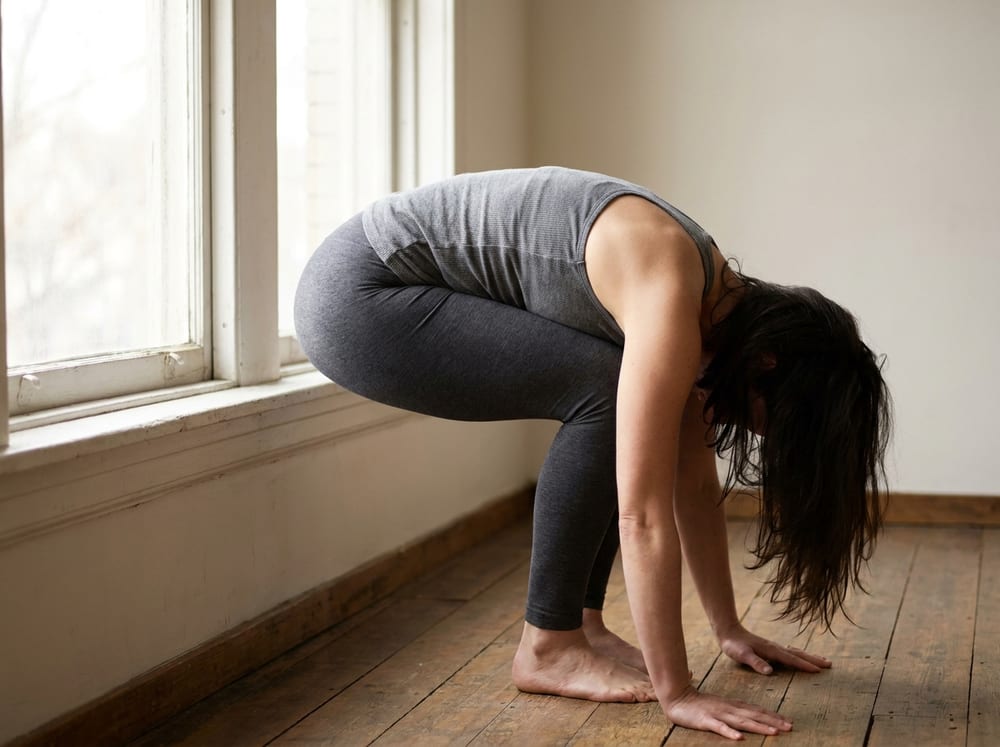
A slow, passive forward hang from standing, knees soft, head and arms just dangling so the entire back of your body finally releases toward the floor.
Why it works
Let your torso hang forward and your head drops below your heart, a mild inversion that stimulates the baroreceptors in your carotid arteries and helps shift your autonomic nervous system from sympathetic, fight-or-flight, toward parasympathetic, rest-and-digest, dominance, slowing your heart rate and turning down how tense you feel. Mechanically, it lengthens your entire posterior chain under gentle gravitational load: the hamstrings, the gastrocnemius, and the thoracolumbar fascia and erector spinae that habitually grip during stress and a full day at a desk. Releasing that chronic paraspinal and hamstring guarding decompresses the lumbar spine and interrupts the clenched-posture feedback loop that keeps a stressed body braced for no reason. That is exactly why a slow fold reliably turns arousal down before bed.
How to do it
- Stand with feet hip-width apart and unlock your knees so they are softly bent, not locked straight.
- Exhale and hinge forward from the hips, letting your spine round gently and your head hang heavy toward the floor.
- Let your arms dangle completely, or hold opposite elbows and let the weight of your arms rock you slowly side to side.
- Release your neck fully so your head feels loose, and let each exhale allow you to sink a little lower without forcing.
- Breathe slowly for the hold, then roll up one vertebra at a time, stacking the head last.
Dose: Hold for 5 to 8 slow breaths, 2 to 3 times, ideally in the evening. Roll up slowly. There's no prize for standing up fast.
⚠ Keep knees bent to protect the low back and hamstrings; never bounce. Roll up slowly and come up gradually if you are prone to dizziness or have low blood pressure, since the head-below-heart position can cause a light-headed spell on rising. Avoid or keep the head higher than the heart if you have uncontrolled high blood pressure, glaucoma, retinal issues, or acute disc pain.