Wall-Supported Hip Airplane
A single-leg standing rotation of your pelvis over a fixed thigh, a wall there for balance, that mobilizes the hip through internal and external rotation while demanding real control the entire time.
Why it works
The hip airplane drives your femoral head through both internal and external rotation inside the joint capsule, while your deep hip stabilizers, the glute medius and the small external rotators, work overtime to control it. Rotational hip mobility is usually the first plane of motion you lose with age, and it's a hidden driver of low-back pain, because a stiff hip forces your lumbar spine to compensate every time you turn or pivot. Combine active rotation with single-leg loading and you're training the hip stabilizers and proprioceptors together, which is exactly the coordination you need to change direction, walk on uneven ground, and catch yourself without a full stumble.
How to do it
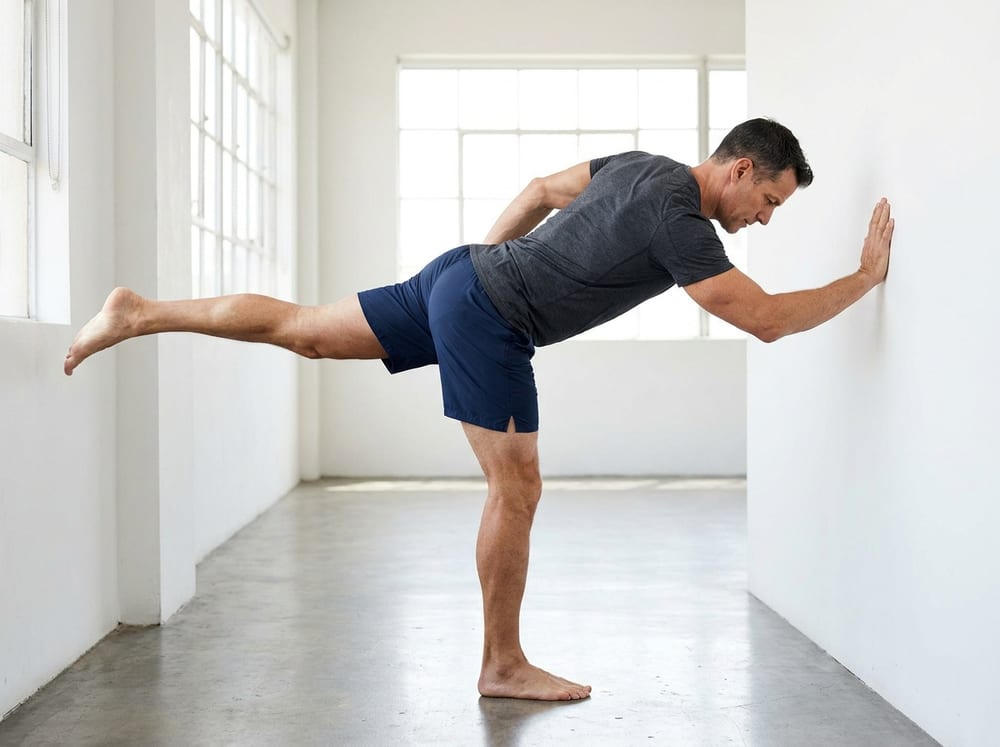
- Stand an arm's length from a wall, place one hand on it, and shift your weight onto the near leg with a soft knee.
- Hinge forward at the hip and extend the other leg straight behind you until your torso and back leg form one line, roughly parallel to the floor.
- Keeping that line rigid, slowly rotate your pelvis open, letting the top hip roll toward the ceiling.
- Rotate back through neutral and close the pelvis the other way, letting the top hip roll toward the floor.
- Move slowly and with control through 6 to 8 rotations, then switch legs.
- Use the wall as much as needed to stay balanced throughout.
Dose: 3 sets of 6 controlled rotations per leg, 3 days per week. Control the whole range or shrink the range, never both at once.
⚠ This is an advanced balance and control drill; always keep a hand on the wall and progress the range gradually. Keep the standing knee soft and never let it cave inward. Skip or regress this if you have acute hip pain or unstable balance, and clear it with a clinician after a hip replacement.