Bolster-Supported Child's Pose for Cramp Relief
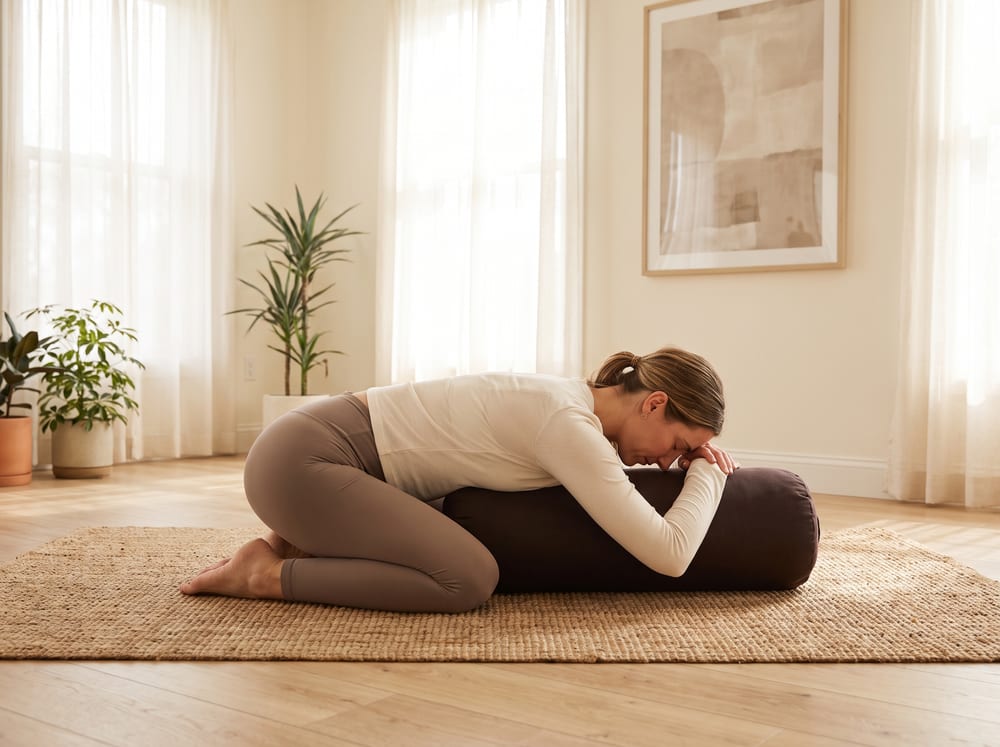
A wide-kneed fold over a bolster or a stack of cushions so your belly and chest get fully supported, hips settle back, and your low back finally gets to lengthen out instead of guarding. You do nothing. The posture holds itself for several minutes while your body handles a rough day.
Why it works
Cramps mostly come from your uterus contracting under a flood of prostaglandins, and that pain gets a second wind from your own low back and abdominal wall reflexively bracing against it. Fold forward over a bolster and you lengthen the muscles running along your lumbar spine and the fascia around them, letting your abdominal wall finally go slack instead of clenching along for the ride. Because the bolster is doing all the holding, this position costs you zero effort, so you can stay in it long enough for that guarding reflex to quiet all the way down. The shape helps too: face supported, body folded in on itself, breathing slower and lower into the belly, which nudges your nervous system out of fight-or-flight and toward rest. None of this is a guess. Randomized trials and reviews on gentle yoga and stretching keep landing on the same finding: period pain intensity goes down.
How to do it
- Kneel on a mat and place a bolster or stack of cushions lengthwise on the floor in front of you.
- Widen your knees to about mat width, bring your big toes toward each other, and settle your hips back toward your heels so there is room for the belly between the thighs.
- Exhale and fold forward, laying your chest and belly along the bolster so it fully supports your torso rather than hanging in space.
- Turn your head to one side or rest your forehead on the bolster or a folded towel, and let your arms drape softly alongside or forward.
- Let the belly rest heavy and breathe slowly and low into the abdomen and back ribs, softening the low back a little more with each exhale.
- Hold, then turn your head to the other side partway through so the neck is not held in one rotation the whole time.
Dose: 1 to 3 supported holds of 3 to 5 minutes, used as needed on a painful day. Stay as long as it's helping.
⚠ This is educational content for discussion with a clinician, not medical advice or a prescription. Place cushions under the hips or between the calves and thighs if the knees or ankles feel strained, and a rolled towel behind the knees if they do not fully bend. Ease off with acute knee injury or if the deep knee bend hurts. Seek medical care for period pain that is severe, worsening, new, or accompanied by fever, heavy bleeding, faintness, or pain outside your normal pattern, since these can signal conditions that need evaluation.