One Hundred and Fifty Minutes a Week, Through a Pregnancy
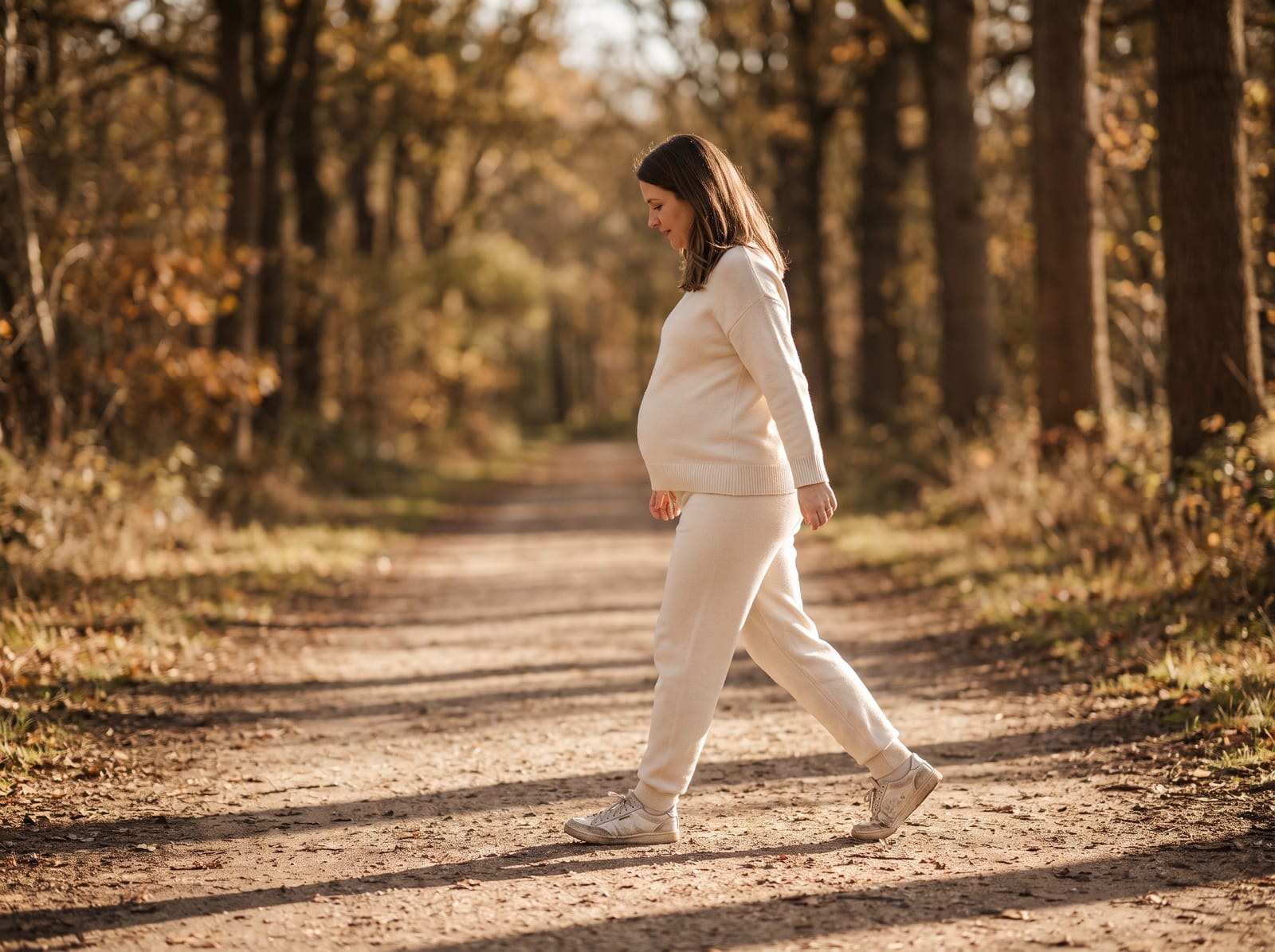
Thirty minutes of brisk walking or stationary cycling, five days a week, at a pace where you can still hold a sentence. That number is not a round guess. It is the figure the 2019 Canadian prenatal activity guideline landed on, and this is the single best-supported thing a body can do with movement during pregnancy.
Why it works
The strength work in this library keeps a pregnant body capable of its own week. This is the piece underneath all of it, and it is the piece with the most behind it. The 2019 Canadian Guideline for Physical Activity throughout Pregnancy (Mottola and colleagues, British Journal of Sports Medicine, 2018) put out a strong recommendation on moderate-quality evidence: at least 150 minutes of moderate-intensity aerobic activity a week, spread across at least three days, with daily movement preferred. The American College of Obstetricians and Gynecologists arrived at the same number in its 2020 committee opinion. Two guidelines reading the same literature and landing on the same figure is worth something. Here is what sits under it. Davenport and colleagues ran the meta-analyses the guideline was built on, a run of them in the same journal. The one covering gestational diabetes and the hypertensive disorders pooled 106 studies and more than 270,000 women, and in the subset limited to exercise-only interventions, prenatal activity came with roughly 38 percent lower odds of gestational diabetes, about 39 percent lower odds of gestational hypertension and about 41 percent lower odds of preeclampsia. A companion review on birth outcomes found lower odds of a baby born over 4 kilograms, with no signal of more preterm births and no signal of babies born small for their dates. The glucose half of that has a clean mechanism. Pregnancy deliberately makes a body insulin resistant in its second half, placental hormones pushing glucose past the mother toward the fetus, and gestational diabetes is what happens when the pancreas cannot keep up with the demand that creates. A contracting muscle pulls glucose in through GLUT4 without waiting for insulin to ask, so a walk takes a bite out of the load by a route that does not depend on the insulin signal working well. The blood pressure half is less settled: better endothelial function and the plasma volume adaptations of training are the usual candidates, and neither has been nailed down in pregnancy. Now the ceiling, because it is a real one. Most of the pooled trials enrolled healthy singleton pregnancies at low risk, and a fair number of participants were already active before they enrolled, which is a different starting point from a first walk in the second trimester. The interventions varied in mode, in weekly dose and in the week they began, so 150 is a pooled convention rather than a threshold anyone tested head to head against 90 or 200. The preeclampsia estimate rests on fewer events than the diabetes one and its confidence interval is wider. Those pools also mixed randomised trials with observational cohorts, so part of the gap between the active and the inactive is the kind of person who was already walking rather than the walking itself. Nobody can blind a walking trial either, and adherence was mostly self-reported. Women carrying twins, women with obesity, and women with existing medical conditions are thin on the ground in this evidence, which is awkward given they are the ones most often asking. Effects on the length or the course of labour are inconsistent, and what any of this does for a child past their birth weight is barely measured. The guideline is also plain that some activity beats none, so a week that reaches 60 minutes is not a failed week.
How to do it
- Get clearance first. In Canada the screening tool is the Get Active Questionnaire for Pregnancy; anywhere else, ask the clinician who is looking after this pregnancy. This step is not a formality, because a handful of conditions rule aerobic work out entirely.
- Pick something you can repeat without planning it: a walking route you already know, a stationary bike, or lane swimming. The trials used ordinary modes and so should you.
- Set the intensity by talking, not by a number on a watch. You should be able to speak in full sentences and not want to sing. Heart rate targets drift through pregnancy and the talk test does not.
- Walk or ride for 30 minutes. If 30 is too much today, do 10 three times. Accumulated minutes counted the same way in the trials.
- Five days a week, or any split that reaches 150 minutes across at least three days. Three long sessions and four blank days is the version most people abandon.
- Drink before you are thirsty and skip the session in real heat or humidity. Raising core temperature is the one part of aerobic work that carries a theoretical risk in the first trimester.
- From the second trimester on, stay off your back for any part of this, including the cool-down stretch. Lying supine can drop blood pressure when the uterus presses on the vena cava.
- Keep going into the third trimester at whatever pace the body still gives you. The number that matters then is the number of days, not the speed.
Dose: Five sessions of 30 minutes a week, or any split reaching 150 weekly minutes across at least three days. Build toward it over a few weeks if you are starting from nothing.
⚠ Educational content for discussion with your clinician, not medical advice and not a prescription. Get clearance before starting. Aerobic exercise is ruled out in pregnancy by a set of absolute contraindications the guideline lists, among them ruptured membranes, premature labour, unexplained persistent vaginal bleeding, placenta praevia after 28 weeks, preeclampsia, an incompetent cervix, growth restriction, a high-order multiple pregnancy, and uncontrolled type 1 diabetes, hypertension or thyroid disease. Several other conditions, including a twin pregnancy after 28 weeks and recurrent pregnancy loss, call for a conversation before you start rather than a flat no. Stop and contact your provider for vaginal bleeding, fluid leaking, regular painful contractions, chest pain, persistent dizziness or shortness of breath before you have even begun, headache, calf pain or swelling, or muscle weakness affecting your balance. Avoid anything with a fall or collision risk, including contact sport, mountain biking and skiing, and avoid scuba diving and exercise at high altitude if you are not already acclimatised. Do not exercise in heat or high humidity, and do not lie flat on your back for any part of a session after the first trimester.