Prenatal Side-Lying Leg Lifts
A side-lying hip drill that builds the outer-hip and glute muscles holding your pelvis steady, done in a position that keeps the weight of your uterus off your major blood vessels and off your back entirely.
Why it works
Your gluteus medius and the other outer-hip muscles are the primary stabilizers of your pelvis during every single-leg moment, walking, climbing a stair, all of it. Pregnancy raises the demand on that group specifically: your pelvis widens, your ligaments loosen, your gait changes, and weakness in those muscles is linked directly to hip and pelvic-girdle discomfort. Side-lying leg lifts load exactly this muscle group using nothing but your own bodyweight, in a controlled position with essentially no fall risk. The side-lying posture itself isn't incidental, it's the whole design. From the second trimester on, lying flat on your back can let the weight of your uterus compress the inferior vena cava and cut down blood return to your heart, so this drill keeps you on your side, which is the recommended resting position for later pregnancy anyway, and it sidesteps any deep abdominal compression too.
How to do it
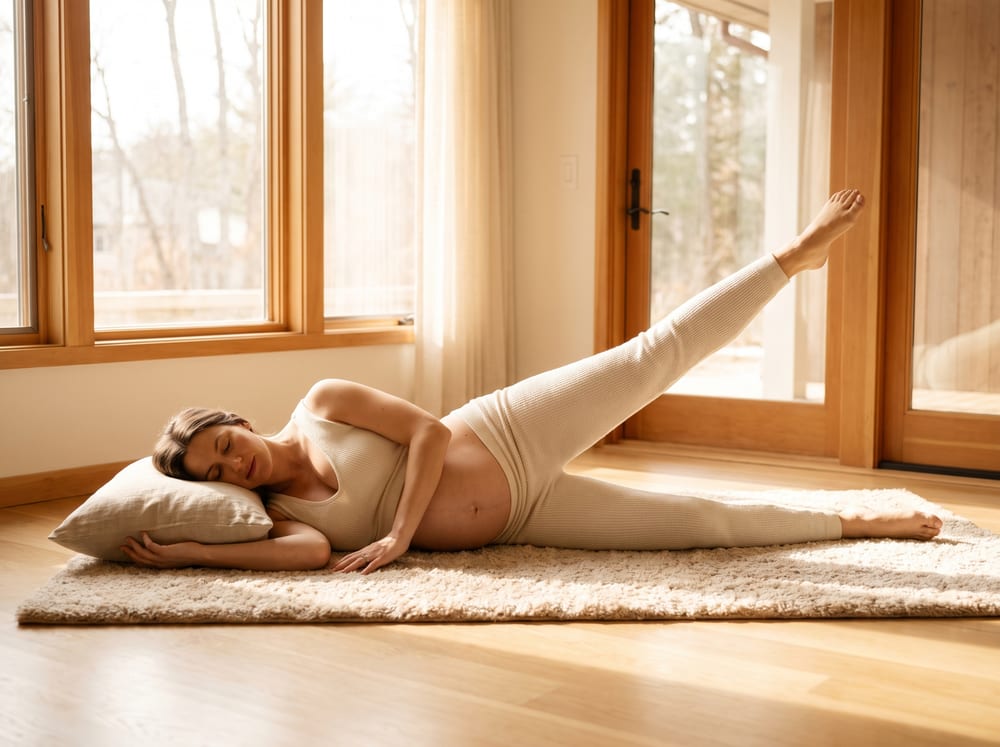
- Lie on your side on a padded mat with a pillow supporting your head so your neck stays in line with your spine, hips and shoulders stacked, and knees slightly bent for a stable base.
- Rest your bottom arm under the pillow and place your top hand on the floor in front of your chest for light steadiness. Keep your torso long and your top hip pointing forward, not rolled back.
- Straighten the top leg in line with your body, then exhale and lift it slowly toward the ceiling to a comfortable height, leading with the heel and keeping the toes pointing forward rather than turning up.
- Lower the leg slowly and with control, stopping just before it rests, keeping tension in the outer hip throughout.
- Complete the set, then roll carefully to the other side and repeat with the other leg. For a gentler version, keep the bottom knee bent and lift a bent top leg (clamshell) instead.
Dose: 2 sets of 10-15 slow lifts per side, 2-3 days per week. Slow and controlled, not momentum doing the lifting.
⚠ Educational content for discussion with your clinician, not medical advice. Get provider clearance before starting, and stop if you have pelvic-girdle or pubic-symphysis pain, which hip abduction can aggravate; a smaller range or the bent-knee clamshell version is gentler. Keep the movement slow and controlled, never hold your breath, and get up from the floor slowly to avoid a blood-pressure drop and dizziness. Trimester modifications: first trimester, the straight-leg version is generally comfortable. Second and third trimesters, stay side-lying rather than rolling onto your back, add a pillow between the knees for comfort, reduce the lift height if the outer hip or round-ligament area complains, and favor the clamshell variation as the belly grows. Stop and consult your provider for bleeding, fluid leakage, contractions, dizziness, or calf pain and swelling.