Prenatal Supported Squat
A shallow, chair- or counter-supported squat that keeps your legs strong for what pregnancy and early parenthood demand of them, with the support taking the balance risk off the table entirely.
Why it works
Squatting trains the big muscles carrying a pregnant body through an ordinary day: the quads, glutes, and hamstrings that stand you up out of a chair, lift a laundry basket, and later, get you up off the couch again and again with a newborn attached to you. Keeping lower-body strength through pregnancy has broad backing from ACOG and other obstetric bodies, who recommend continued resistance and functional exercise through an uncomplicated pregnancy, on the logic that preserved strength supports posture, mobility, and how well you bounce back postpartum. Holding a countertop, sturdy chair, or door frame is the key move here, not an afterthought: pregnancy relaxes your ligaments, partly through the hormone relaxin, and shifts your center of gravity forward, which quietly degrades balance. External support takes fall risk off the table while your legs still do the real work. Keeping the squat shallow and controlled also steers you away from the deep end-range positions that can aggravate pelvic-girdle pain. Be straight with yourself about one thing: the evidence that squatting eases labor or delivery is limited and inconsistent, so this drill earns its place for strength and function. It is not a birth-prep promise.
How to do it
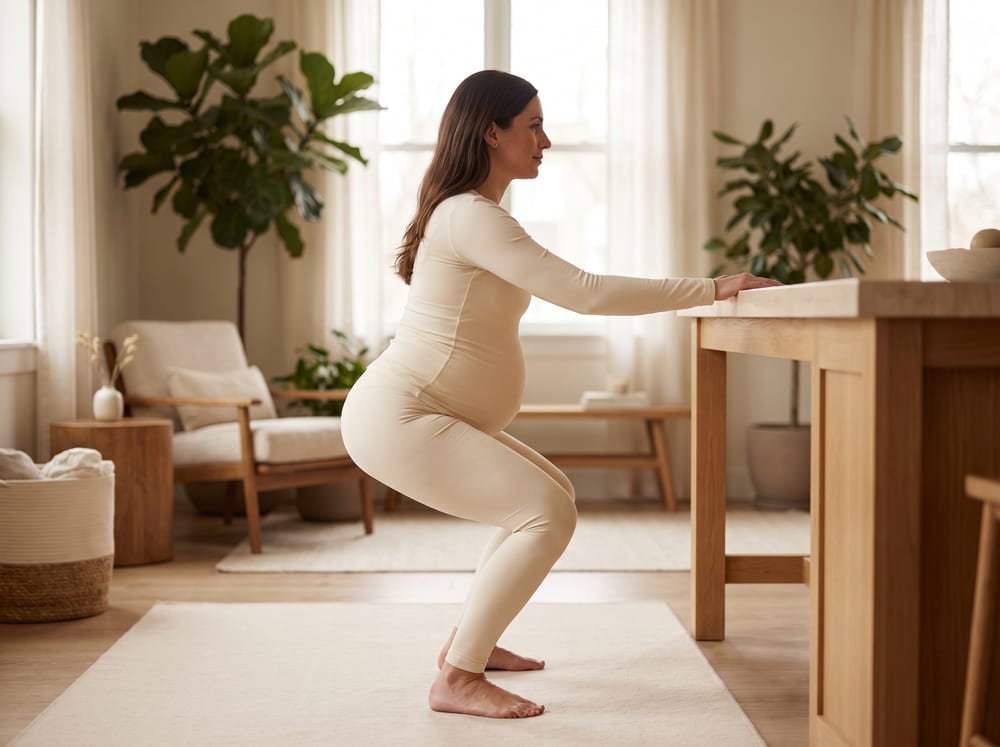
- Stand upright facing a sturdy countertop or the back of a heavy chair, feet a little wider than hip-width, toes turned slightly out, and rest your hands lightly on the support.
- Keeping your chest lifted and spine tall, hinge back at the hips as if reaching your seat toward a chair behind you, letting your knees bend and track over your toes.
- Lower only to a comfortable, controlled depth, keeping your heels down and using the support for balance rather than pulling yourself down with your arms. Do not force depth.
- Exhale and press evenly through your feet to stand back up, gently engaging the glutes without holding your breath.
- Pause tall at the top, resetting your posture, then repeat at a slow, controlled tempo.
Dose: 2-3 sets of 8-12 controlled squats, 2-3 days per week on non-consecutive days. Shallow and controlled beats deep and risky, every time.
⚠ Educational content for discussion with your clinician, not medical advice. Get provider clearance before starting resistance work in pregnancy, and stop if you have pelvic-girdle or pubic-symphysis pain, which squatting can aggravate. Always use support, keep the depth shallow and controlled, and never hold your breath or bear down, since straining raises intra-abdominal and pelvic-floor pressure; exhale on the effort. Avoid unsupported or jumping squats entirely because of fall risk. Trimester modifications: first trimester, a moderate supported squat is generally fine. Second and third trimesters, widen the stance, reduce the depth, and rely more on the support as balance and the center of gravity shift; if standing up from low positions provokes dizziness, rise slowly. Stop and consult your provider for bleeding, fluid leakage, contractions, calf pain or swelling, chest pain, or dizziness.