Six-Machine Strength Session for Skin
Three sets of ten on six weight-stack machines, twice a week. This is the resistance arm of the one trial that measured skin elasticity and dermal thickness before and after, run at the loads and the cadence that trial used.
Why it works
Skin is tissue with a blood supply, a matrix of collagen and proteoglycans holding it up, and an inflammatory environment it sits in. The argument for lifting is that all three of those answer to training the whole body rather than to anything done to the face. Nishikori and colleagues tested it head to head in Scientific Reports, 2023: 61 sedentary middle-aged Japanese women, 56 of them in the analysis, randomized to sixteen weeks of either stationary cycling or resistance training, twice a week either way. The resistance arm ran three sets of ten on six weight-stack machines, leg curl, leg extension, arm curl, rowing, shoulder press and chest press, starting near half of a one-repetition maximum and progressing to 75 or 80 percent as ten reps in the third set became available. That protocol is the session written below, which is the reason to write this entry at all rather than a session invented to look like it. Both arms improved skin elasticity, measured as the elastic recovery rate, which in the resistance group went from 0.32 to 0.38 at a p below 0.001, and both improved the structure of the upper dermis. The paper's headline is that resistance training also improved dermal thickness, and that claim deserves a closer look than the abstract gives it: the reported change is 1.77 mm to 1.79 mm at p = 0.20, against 1.71 mm to 1.71 mm in the cycling group. Two hundredths of a millimeter, at a p-value most readers would take as no change. So what this trial supports is the elasticity result, in both groups, and the thickness line that gets quoted everywhere else rests on less than the quoting suggests. For the mechanism the authors screened well over a thousand circulating factors and found the two kinds of training moved different ones. What fell after resistance training included monocyte chemotactic protein 3 and CCL28, rather than the IL-6 or C-reactive protein most exercise-and-inflammation work reports. They then took plasma from the participants, put it on cultured human dermal fibroblasts, and watched matrix gene expression rise, biglycan among them. Those are cells in a dish reading a blood sample rather than a measurement of anyone's own dermis, and the authors say as much, asking for animal work before the mechanism is called settled. The list of what is unknown here is longer than the list of what is. There was no non-exercising control group, so four months of measurement drift and seasonal change in skin sit inside the result with nothing to subtract them against. One trial, one country, women only, all sedentary at the start, sixteen weeks. No dermatologist scored anyone's face blind, and nobody asked whether any of this shows up as a difference a person can see in a mirror. Ultraviolet exposure is still the largest single driver of visible skin aging, and nothing in this trial suggests weights substitute for shade and sunscreen.
How to do it
- Warm up for five minutes: easy walking or an unloaded bike, then a set of ten on the first machine at a weight that feels like nothing.
- Leg curl, three sets of ten. Sit or lie as the machine sets you, curl to the point where the hamstrings are working rather than the knees, and lower over about three seconds.
- Leg extension, three sets of ten. Straighten the knees without snapping them locked at the top, pause a beat, and come down under control.
- Arm curl, three sets of ten. Elbows stay by the ribs, the shoulders stay down, and the weight comes up without the torso swinging behind it.
- Rowing, three sets of ten. Pull the handles toward the lower ribs, let the shoulder blades come together at the end of the pull, and reach forward fully between reps.
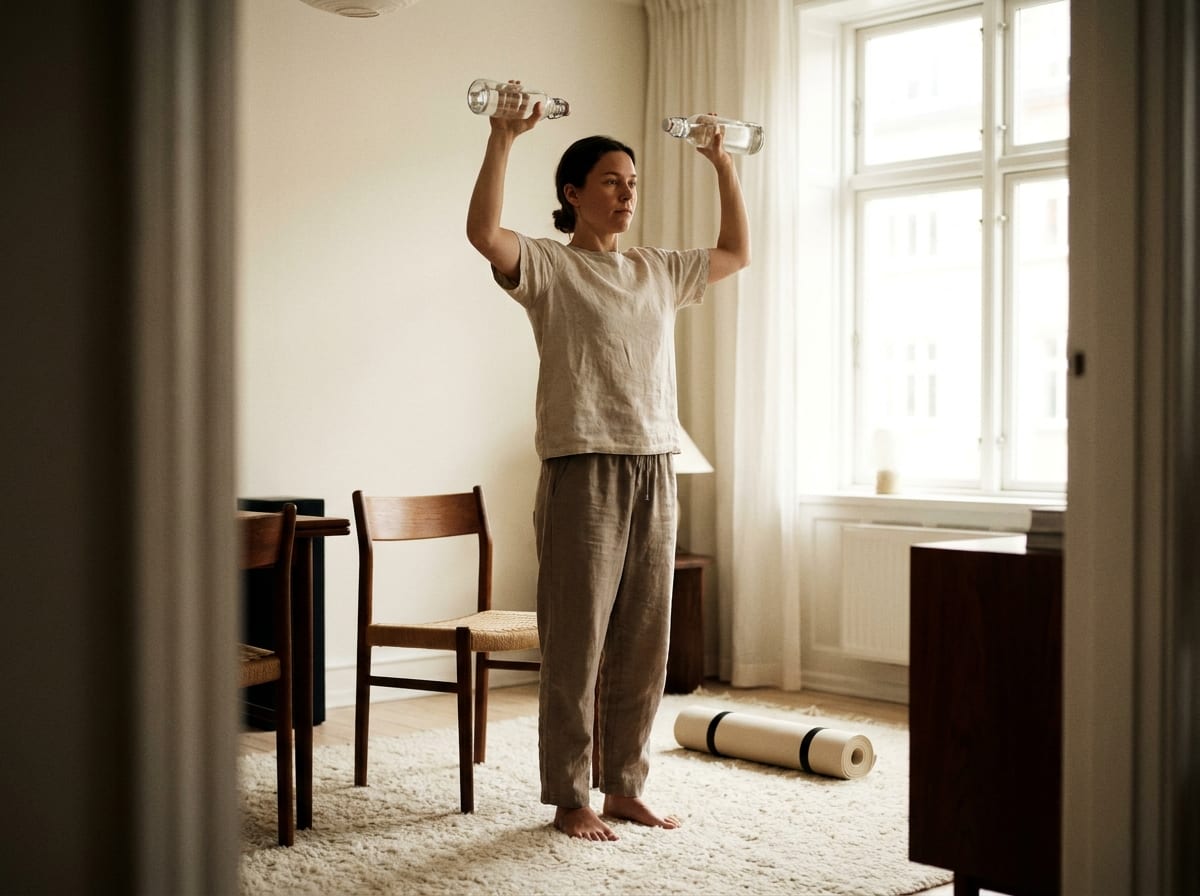
- Shoulder press, three sets of ten. Ribs down, press overhead to almost straight, and stop short of any range where the shoulder complains.
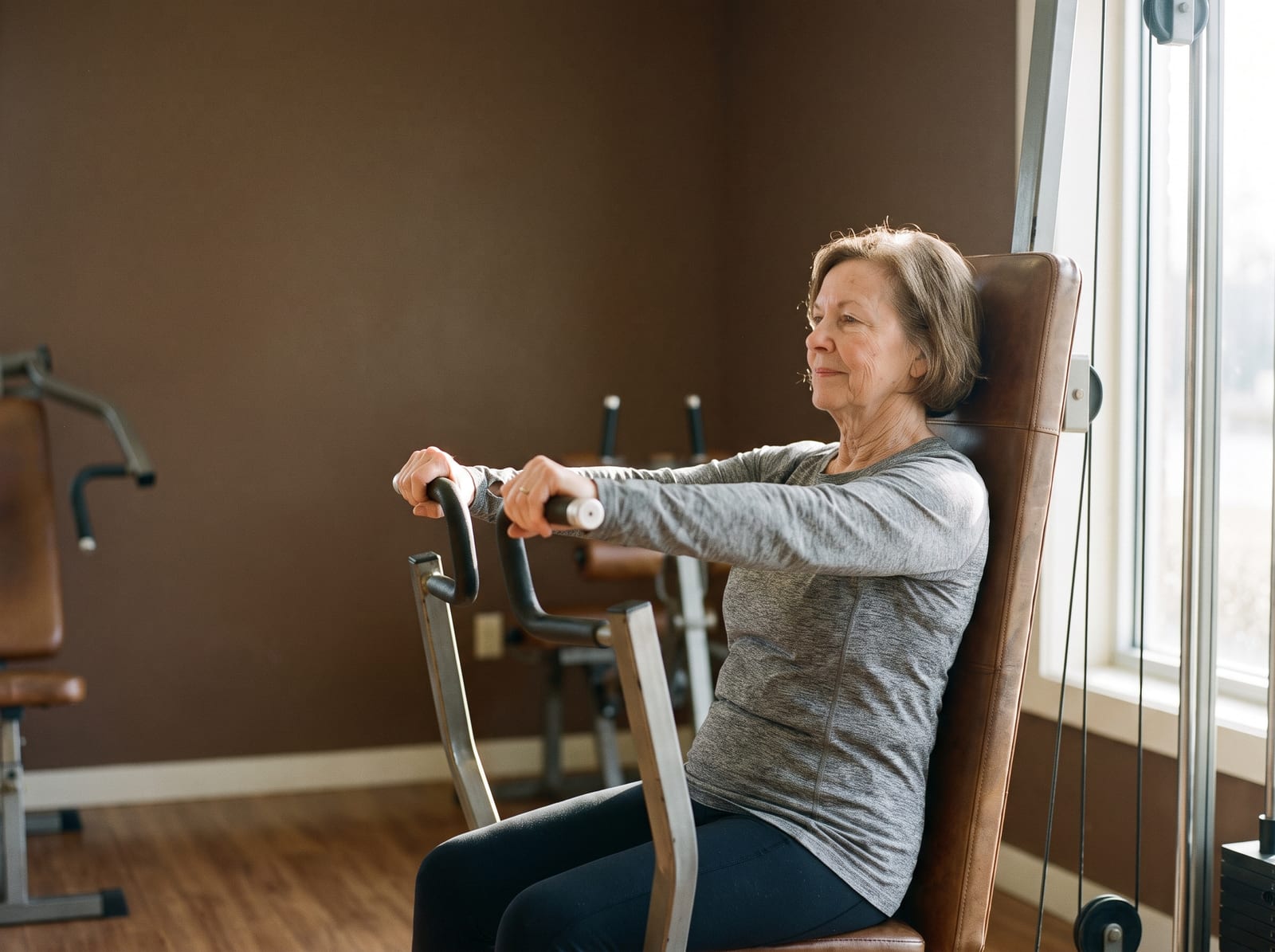
- Chest press, three sets of ten. Take the handles to about the depth where the upper arms are level with the torso, then press back out.
- Rest 60 to 90 seconds between sets, and breathe out on the effort rather than holding your breath through it.
- Finish with five minutes of easy walking and whatever stretching you like.
Dose: Three sets of ten on each of the six machines, twice a week, with at least one day between sessions. Start around 50 percent of the heaviest weight you could move once, and add roughly 5 percent whenever you finish all ten reps of the third set. The trial ran sixteen weeks, so give it a season before deciding anything about it.
⚠ Educational content for discussion with a clinician, not medical advice and not a prescription. Get clearance before starting if you have a cardiac condition, uncontrolled high blood pressure, a hernia, a retinal condition, or recent surgery. Breathe out on the effort: holding your breath under load pushes blood pressure up sharply. Sharp joint pain means stop that movement rather than work through it, and the first two weeks should feel easy on purpose, since the trial started people at half their maximum and built from there. Whatever this does for skin, it does nothing about sun exposure, so the sunscreen and the shade stay where they are.