Steady Cycling Session for Skin
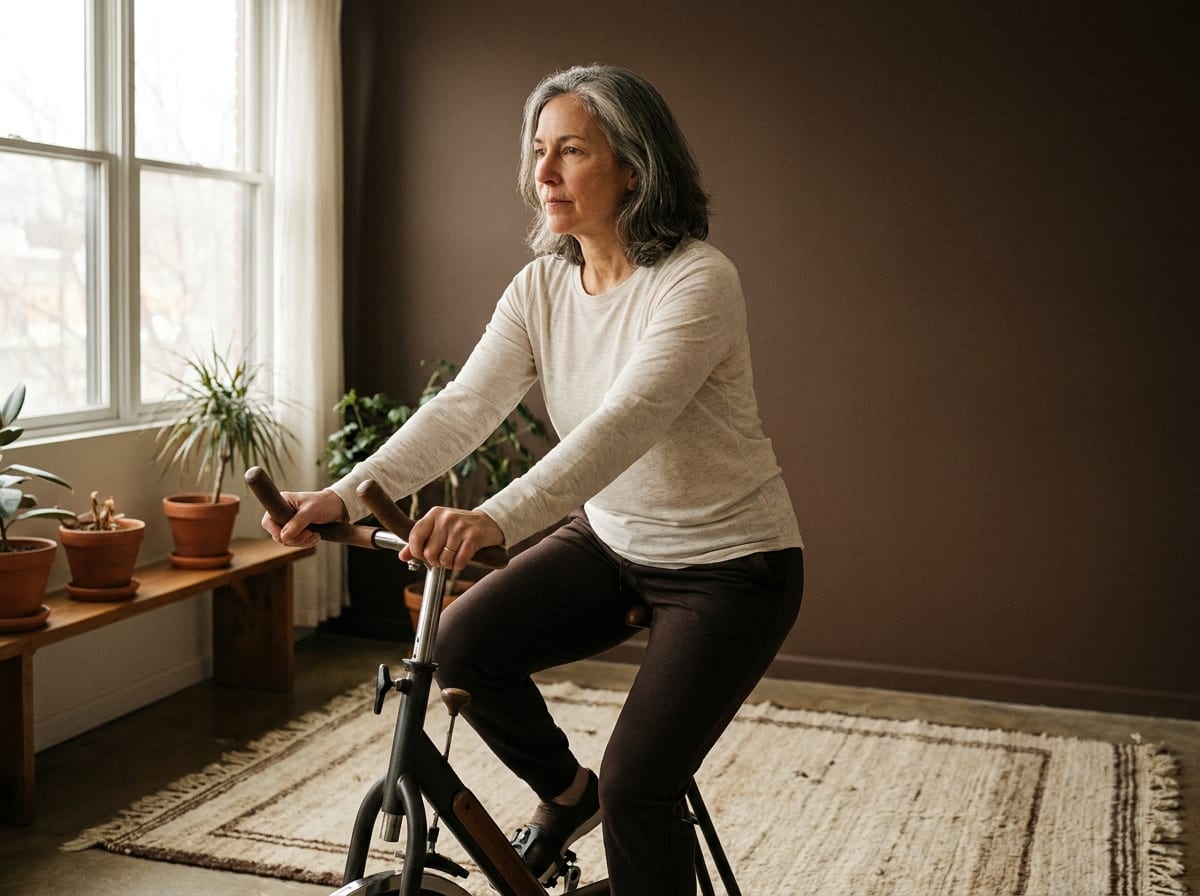
Thirty minutes on a bike at a pace you can still talk through, two or three times a week. Cycling is what both research groups used when they went looking for changes in skin, so cycling is what this says.
Why it works
Your skin is an organ with a blood supply and a metabolism, and aerobic training is the thing that reworks blood supply and metabolism. That is the mechanism in one sentence. The only question worth asking is whether anyone has bothered to biopsy people and check, and two groups have. Crane and colleagues at McMaster, Aging Cell, 2015, took skin biopsies from men and women spanning ages 20 to 84. The ones past 65 who were doing at least three hours a week of moderate-to-vigorous aerobic work had an outer layer and a dermis closer in composition to a 20-to-40-year-old's than to their sedentary age-matched peers. That half is cross-sectional and proves nothing about cause, because fit 70-year-olds differ from sedentary ones in about a hundred ways at once. So the same group took previously sedentary people over 65, put them on a bike twice a week for three months, and biopsied them again. The composition shifted. The intervention group was small, and that is the honest ceiling on how hard you can lean on it. Then Nishikori and colleagues, Scientific Reports, 2023: sixteen weeks, 56 sedentary middle-aged Japanese women split between resistance training and cycling. Both groups improved skin elasticity and upper dermal structure. Here is the part that matters for this session specifically, and I am not going to bury it. Only the resistance group gained dermal thickness. The cycling arm did not. So the bike has the evidence for the surface properties, the weights have the better claim on thickness, and doing both is the answer nobody wants. Crane's proposed mechanism was interleukin-15, a signal working muscle releases, acting on skin mitochondria. That part was worked out in mice. In you it is a plausible signal and a hypothesis, nothing further. What nobody measured in either study: whether any of it shows up as a face a stranger would rate differently in a photograph. These are elasticity readings and biopsy composition, not blinded dermatologists scoring wrinkles. Both trials were small, one of them enrolled women only, and neither ran long enough to say what a decade of this does.
How to do it
- Warm up for five minutes, spinning at a light resistance until your legs feel awake and your breathing has picked up.
- Raise the resistance until you are working at a moderate effort: breathing harder than normal, able to speak a full sentence but not deliver a monologue, roughly a five or six out of ten.
- Hold that for thirty minutes. Keep the cadence smooth and steady rather than surging and coasting, since the steady part is what both trials tested.
- Sit tall for a minute every ten minutes, shoulders back and hands light on the bars, so your neck and upper back do not spend half an hour locked in one shape.
- Cool down for five minutes at an easy spin, then get out of damp clothing and rinse off before you sit around in it.
Dose: 30 minutes, 2 to 3 times a week. Crane's group rode twice a week for three months and Nishikori's rode for sixteen weeks, so give it a season before you go looking for anything.
⚠ This is educational content for discussion with a clinician, not medical advice or a prescription. If you take this session outdoors, the sun matters far more to your skin than the ride does. Ultraviolet exposure is the largest single driver of visible skin aging, and no amount of cycling offsets it: ride early or late, use a broad-spectrum sunscreen and reapply it once you have sweated through it, and cover what you can. Clear moderate aerobic work with a clinician first if you have a cardiovascular condition, uncontrolled high blood pressure, or have not exercised in years. Stop for chest pain, palpitations, or dizziness. If you have a skin condition that flares with heat, friction, or sweat, keep the session cooler and shorter, and rinse and change promptly afterward.