Supported Goblet Squat with a Household Load
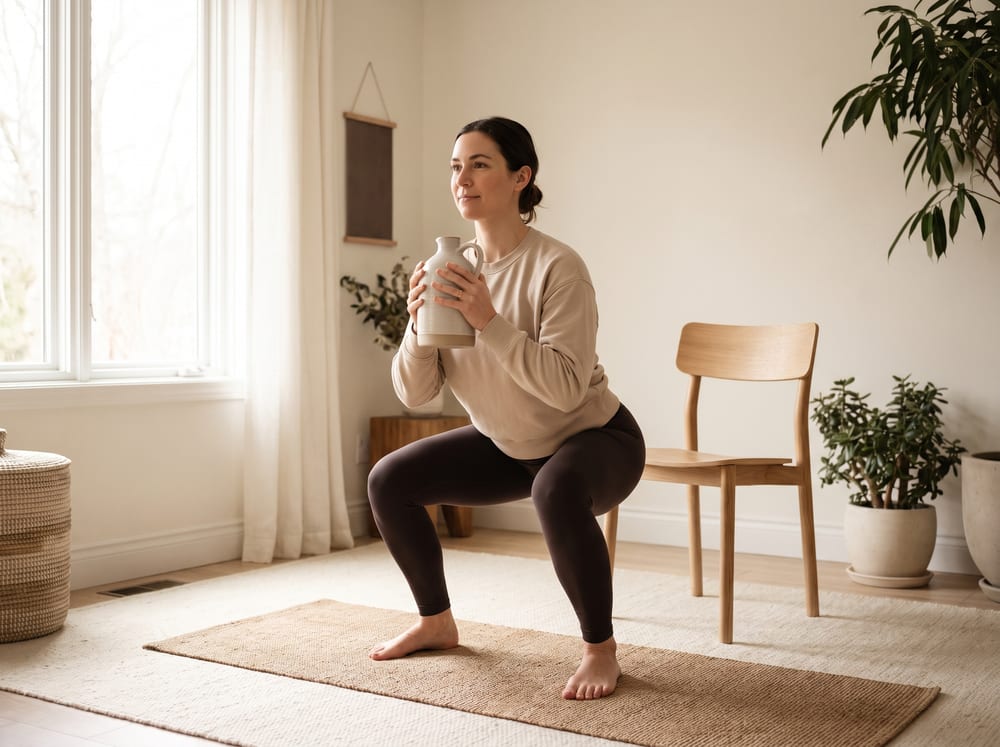
A slow, controlled squat holding a weighted household object at your chest, a wall or chair nearby for reassurance, building real lower-body and glute strength that supports healthy body composition without tipping into the exhaustive training that can work against fertility.
Why it works
Moderate resistance training is one of the more consistently evidence-backed levers on the metabolic side of fertility, in both women and men. The big muscles doing the work in a squat, your quads and glutes, are your body's biggest sink for glucose disposal, and loading them regularly improves insulin sensitivity. That matters because insulin resistance and excess central body fat are strongly linked to disrupted ovulation, PCOS especially, and to lower testosterone and weaker sperm parameters in men. Building lean muscle also shifts body composition toward the range associated with more regular cycles and better hormonal balance, a plausible route by which resistance training may support conception. Be clear-eyed about the evidence tier: it's moderate, largely observational, and drawn mostly from metabolic and PCOS research rather than large fertility trials specifically. And here's the part that matters for how you train: this prescription is deliberately moderate on purpose. Very high training volume and very low body fat can suppress the reproductive axis, so the goal is a sustainable strength stimulus, not maximal fatigue.
How to do it
- Stand tall and vertical with feet a little wider than hip width, toes turned slightly out, a wall or chair beside you for light support.
- Hold the weighted object against your chest with both hands, elbows tucked, spine long and shoulders relaxed.
- Breathe in, brace your midsection gently, and sit your hips back and down as if lowering onto a low stool, keeping your chest upright.
- Descend only as far as you can while keeping your heels flat and your knees tracking over your toes, pausing when thighs approach parallel or at a comfortable depth.
- Breathe out and drive through your whole foot to stand back up tall, squeezing the glutes at the top without locking the knees.
- Move slowly and stop several repetitions short of failure so effort stays moderate, never maximal.
Dose: 2-3 sets of 8-12 slow repetitions, 2-3 non-consecutive days per week, keeping every set well short of exhaustion. Moderate is the whole strategy, not a compromise.
⚠ This is educational information for discussion with your clinician, not medical or fertility advice. If you are pregnant or trying to conceive, clear a resistance routine with your care team first, and stop the moment you feel breath-holding strain, pelvic pressure, or dizziness. Keep effort moderate: overtraining and very low body fat can impair, not help, fertility. Start with body weight alone before adding load, keep support within reach, and avoid straining or aggressive breath-holding, which spikes intra-abdominal and blood pressure.