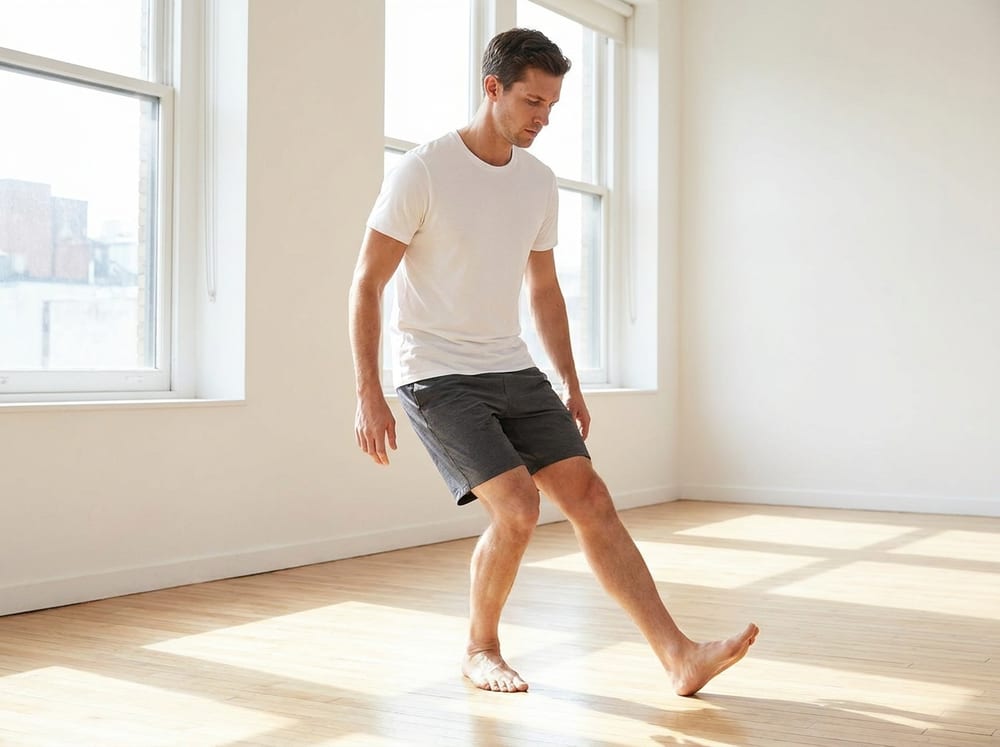
Tandem Heel-to-Toe Walk
Walk an imaginary straight line, heel of one foot landing directly against the toes of the other, narrowing your base of support to almost nothing while you're moving.
Why it works
Tandem walking shrinks your side-to-side base of support down to almost nothing, which forces your hip abductors and adductors and your ankle stabilizers to control side-to-side sway dynamically, while your whole body is still moving forward. It also loads the vestibular system through head and trunk translation, not just quiet standing in place. This is exactly what's demanded of you walking through a narrow space, along a curb edge, or turning through a crowd. It's a standard clinical assessment for a reason: performance on it tracks real-world mobility closely. Train it and you build stride confidence, cut down the wide-based shuffling gait that creeps in with age, and strengthen the reactive control that keeps a misstep from turning into a fall sideways.
How to do it
- Choose a hallway so a wall is within reach on one side, and pick a straight line on the floor to follow.
- Step forward and place the heel of your front foot directly touching the toes of your back foot.
- Fix your gaze on a point ahead at eye level rather than looking down at your feet.
- Continue placing heel to toe along the line, pausing a beat on each step to find stability.
- Walk 10-20 steps, turn around slowly with a wide base, and repeat.
Dose: 3-4 passes of 10-20 steps, 3-4 days per week. Progress by looking straight ahead instead of down at your feet.
⚠ Keep a wall or rail within reach, especially on turns, which are the least stable moment. Slow down and widen your stance to turn rather than pivoting on a narrow base.