Doorway Chest and Shoulder Opener
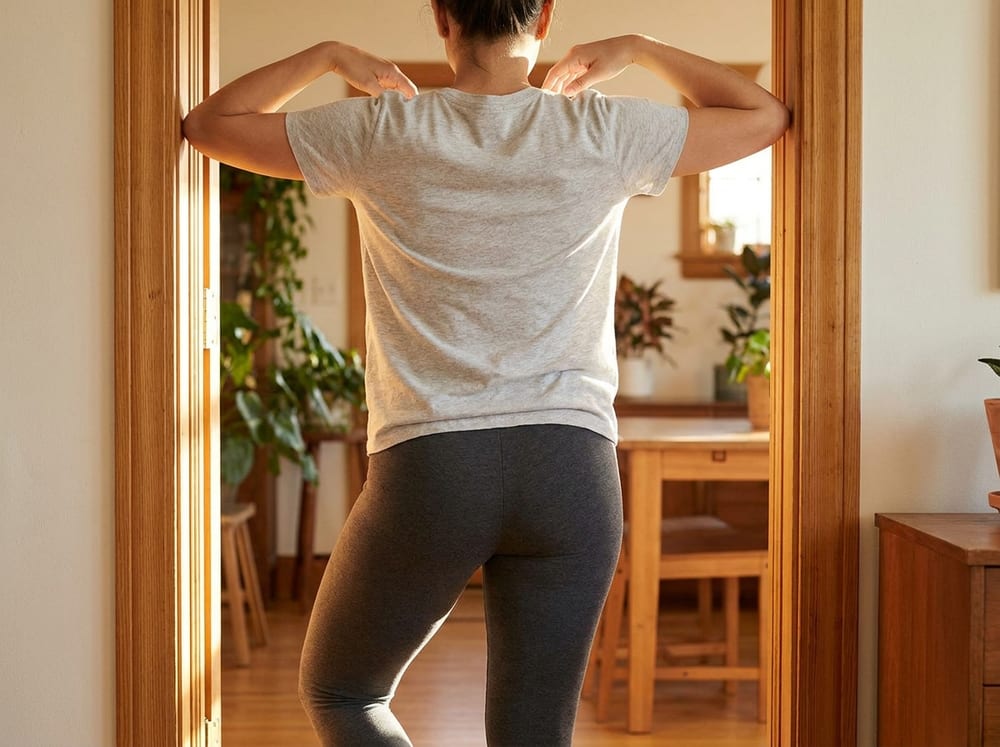
A standing stretch using a doorway or wall corner to lengthen the chest and front-of-shoulder tissue that desk work and hours on your phone tighten up, actively reversing that rounded-shoulder slump.
Why it works
Hours of forward-reaching activity shorten your pectoralis major and minor and your anterior shoulder capsule while your mid-back gets long, weak, and forgotten. That adaptive shortening drags your shoulders forward and tips your head into a permanent protraction, which over time reduces shoulder external rotation, compresses the rotator cuff every time you reach overhead, and stiffens the thoracic spine along with it. Stretch the pecs across a doorway and you restore their resting length, letting the shoulder blade sit back on the ribcage where it belongs, which mechanically opens up the subacromial space. For aging adults, that protects against impingement, keeps the overhead reach you need for getting dressed and reaching a shelf, and helps offset the hunched, kyphotic posture that quietly eats into your breathing capacity.
How to do it
- Stand in a doorway and place your forearms on the frame with elbows bent about 90 degrees, roughly at shoulder height.
- Set one foot slightly ahead of the other for a stable split stance.
- Gently shift your weight forward through the doorway until you feel a comfortable stretch across the front of the chest and shoulders.
- Keep your ribs down and low back neutral, do not arch the lower back to reach further.
- To bias the lower chest, raise the elbows a few inches higher; to bias the upper chest, lower them, and breathe slowly into the stretch.
Dose: 3 holds of 30 seconds, 1-2x a day, daily. Feel it in the chest, not the joint.
⚠ Ease off if you feel any pinching in the front of the shoulder or tingling in the arm; the stretch should be felt in the chest, not the joint. Avoid if you have a history of shoulder dislocation without clearing it with a clinician.