Shaken Dalgona Protein Coffee
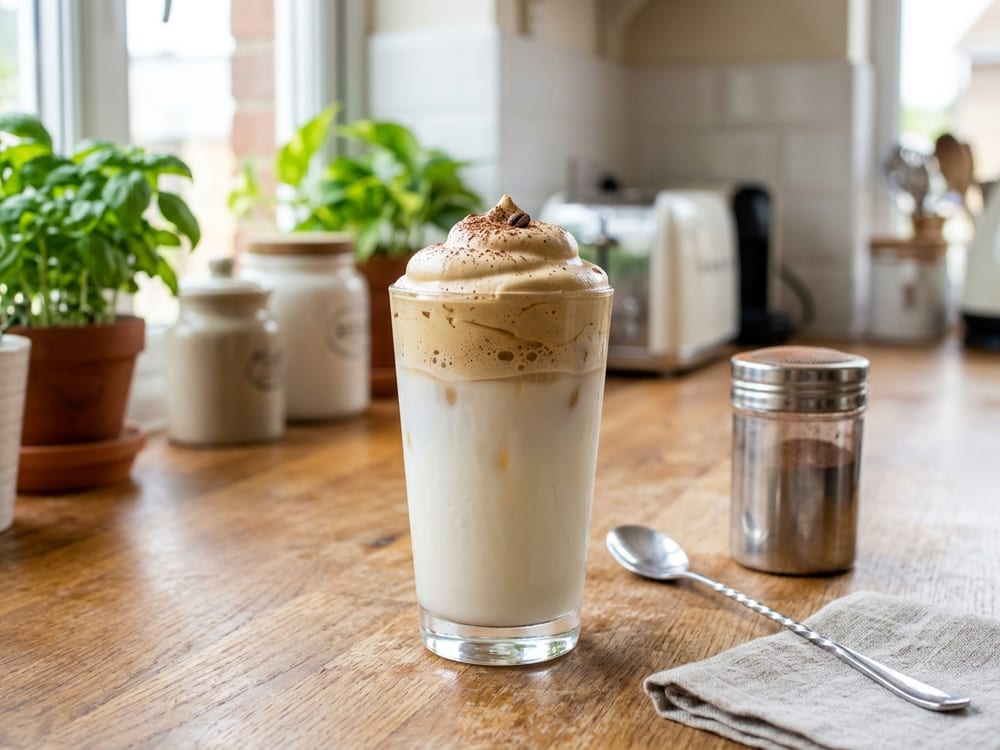
Instant coffee, a little sugar, and unflavored collagen peptides get shaken hard in a jar until they turn into a thick pale foam, then spooned over a fresh glass of cold milk. A coffee snack that carries real protein instead of just caffeine.
Why it works
Coffee, caffeinated or decaf, gets your colon moving, and fast. Studies with real sensors down there have clocked it working within minutes, way faster than the same amount of hot water alone, which is most of why a morning coffee reliably prompts a bowel movement for so many people. The caffeine in even this small amount of instant coffee also blocks adenosine receptors in the brain, producing the lift in alertness and reaction time most people feel within about half an hour. The whipped foam itself, coffee, sugar, and hot water, is mostly trapped air and carries almost no protein, so the real nutrition comes from the collagen peptides shaken directly into it: about 18 grams of protein per serving, spooned over a fresh glass of milk, enough to soften the return of hunger that a plain black coffee does nothing for. Collagen is not a complete protein on its own. It runs low on tryptophan. It earns its place here for its amino acids, and for a practical reason: it dissolves clear into hot liquid without clumping, so it can be shaken straight into the foam, while whey's protein structure tends to clump when whipped hot and works better stirred into cold milk instead.
Coffee's effect on colon motility and caffeine's effect on alertness both rest on a solid base of controlled human studies. That part isn't up for debate. Collagen peptides for skin elasticity and hydration have a smaller, newer set of randomized trials behind them, nowhere near as settled as the evidence for whey and muscle protein synthesis. It's here mainly for how cleanly it dissolves into a hot foam, not for a guaranteed skin benefit.
Ingredients
- 4 tbsp (24 g) instant coffee granules
- 3 tbsp (36 g) granulated sugar
- 4 tbsp (60 ml) just-boiled water
- 80 g (about 4 tbsp) unflavored collagen peptides, or 4 scoops (about 120 g) vanilla whey protein powder stirred into the milk instead of the hot mixture
- 4 cups (960 ml) cold 2% milk or milk of choice, one cup added fresh per serving
- Ice cubes, for serving (optional)
Method
- Combine the instant coffee, sugar, just-boiled water, and collagen peptides (if using) in a jar or bowl with a tight-fitting lid. Collagen peptides dissolve clear into hot liquid without clumping, so they can go straight into the mixture that gets whipped.
- Seal the jar and shake hard for 3 to 4 minutes, checking every minute or so, until the mixture turns pale tan and holds its shape in soft peaks when you tip the jar. A whisk or hand mixer works too, and gets there faster than shaking by hand.
- Pour a fresh glass of cold milk for each serving, over ice if you want it iced, and spoon 2 to 3 tablespoons of the whipped foam on top. Stir gently to marble the foam through, or leave it floating and stir as you drink.
- Refrigerate the rest of the foam in an airtight container for the remaining servings through the week. Give it a quick ten-second re-whisk before spooning if it has deflated some.
- To use whey instead of collagen, leave it out of the whipped mixture, since it tends to clump when whipped hot, and stir a scoop into the cold milk of each glass instead.