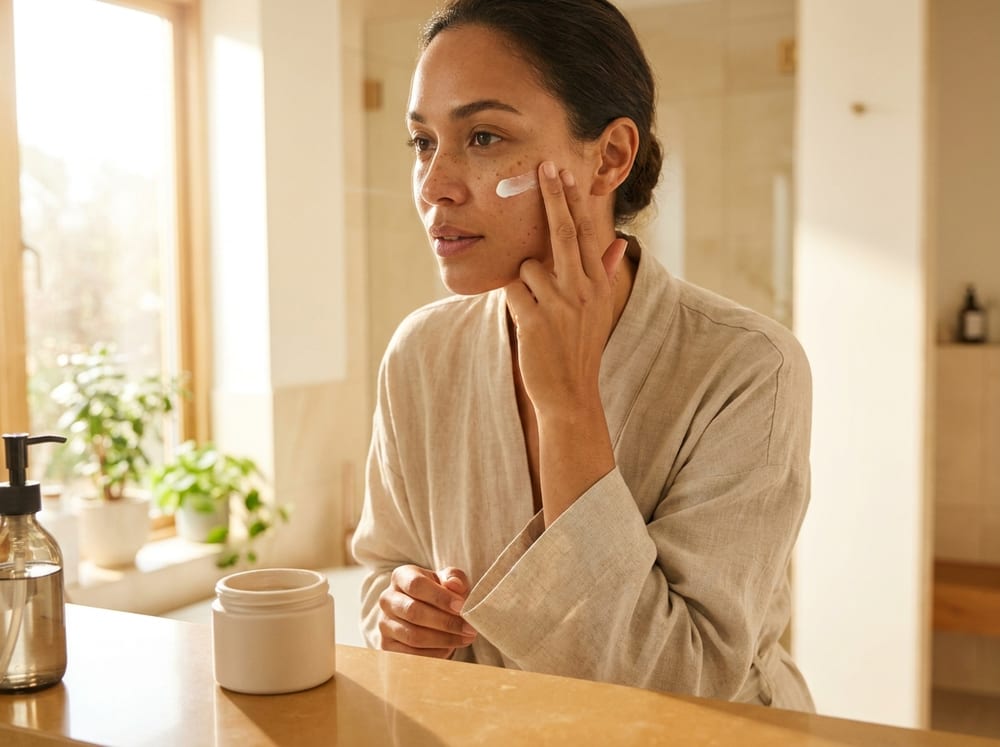
Retinoid (Retinal) Night Treatment
Retinal, also called retinaldehyde, is a vitamin A derivative, and it only needs one conversion step to become active retinoic acid in your skin. Once it's there, it binds retinoid receptors and gets to work. Cell turnover speeds up. Collagen production climbs. Pores start shedding cells the way they're supposed to instead of clogging up. One ingredient, three problems handled at once: fine lines, uneven texture, clogged pores. That's the whole deal.
Why it works
Prescription tretinoin is the gold standard here, strong evidence, long track record, for both photoaging and acne. That part's not up for debate. Retinal is more bioavailable than retinol and posts promising 8-week clinical results for texture and photoaging in its own right. What's still missing: real head-to-head data against tretinoin. Nobody's run that fight yet.
How to use it
- Night only, on skin that's clean and fully dry.
- Dot a pea-sized amount across your face and spread it gently. That's plenty.
- Keep it away from the immediate eye area and the corners of your nose and mouth.
- Start at two nights a week. Build up only once your skin proves it can take more.
- Flaking? Buffer with moisturizer first. And SPF the next day is not optional.
- Skip it entirely during pregnancy and breastfeeding. No exceptions.
At night on clean, fully dry skin, a pea-sized amount dotted across the face and gently spread, avoiding the immediate eye area and corners of the nose and mouth. Apply before your moisturizer; a buffering layer of moisturizer first can ease irritation while your skin adjusts.
For men: Freshly shaved skin and retinal do not mix: apply on the nights you have not just shaved, or wait until that area has fully calmed down. Put a razor and retinal together and you are not doubling the irritation, you are multiplying it.
⚠ Avoid during pregnancy and breastfeeding. Introduce slowly to limit dryness, flaking, and irritation, and always pair with daily SPF since retinoids increase sun sensitivity. This is educational information for discussion with a clinician, not a prescription or medical advice.