Sixteen Weeks of Tai Chi, Before a Shingles Vaccine
Forty minutes of slow, weight-shifting tai chi, three times a week, for four months. In the trial it comes from, older adults who did it arrived at their vaccination carrying more virus-specific immunity than they started with.
Why it works
The trial is small and it is specific, so start there. In 2007, Michael Irwin and colleagues at UCLA published a randomized trial in the Journal of the American Geriatrics Society. A hundred and twelve adults between fifty-nine and eighty-six were assigned either to sixteen weeks of Tai Chi Chih, forty minutes a session, three sessions a week, or to sixteen weeks of health education classes. At the end of those sixteen weeks everyone received a live varicella zoster vaccine, and the researchers counted how many of each person's T cells recognized the virus. The tai chi group's virus-specific immunity rose about twice as fast as the class group's. The increase tai chi produced on its own, before anyone was vaccinated, was comparable in size to what the vaccine alone did for the control group. An earlier and smaller study from the same lab, thirty-six older adults over fifteen weeks, published in Psychosomatic Medicine in 2003, had pointed the same way. The mechanism the authors argue for is unremarkable and probably correct as far as it goes: immunity to varicella zoster declines with age, chronic stress arousal pushes it down further, and a slow weight-bearing practice that lowers sympathetic tone while asking something modest of the legs and the aerobic system nudges it back up. Nobody measured that chain directly. It is inference stitched between two ends of a result. Now here is what nobody knows, and it is a lot. The outcome measured was a laboratory count of T cells that recognize the virus, not how many people got shingles. No trial has ever tested tai chi against shingles cases themselves, and a cell count is not a case count. Both immune trials came out of one research group at one university, and no independent lab has replicated the finding. Everyone enrolled was fifty-nine or older, so nothing here transfers to a person in their thirties. And the vaccine in that trial was the live varicella vaccine, not Shingrix, the recombinant shingles vaccine given today, which works by a different route and is far more effective on its own. Nobody has run tai chi alongside the vaccine people receive now. So treat the immune result as a reason to take the practice seriously, not as a claim it will keep you from getting shingles. The reason this entry earns its place even if you set that result aside entirely is the falls evidence, which is much stronger. Fuzhong Li and colleagues randomized six hundred and seventy adults aged seventy and over, all at high risk of falling, to twenty-four weeks of therapeutic tai ji quan, a multimodal exercise programme, or stretching, and published it in JAMA Internal Medicine in 2018. The tai chi group fell fifty-eight percent less often than the stretching group and thirty-one percent less often than the multimodal exercise group. Falls are what ends independence in later life. That number stands up on its own, whatever the T cells are doing.
How to do it
- Find the form before you find the time. The trial used Tai Chi Chih, a set of nineteen slow movements and a closing pose, learned from an instructor. Any gentle standing tai chi taught by someone competent is closer to what was tested than guessing at it from memory.
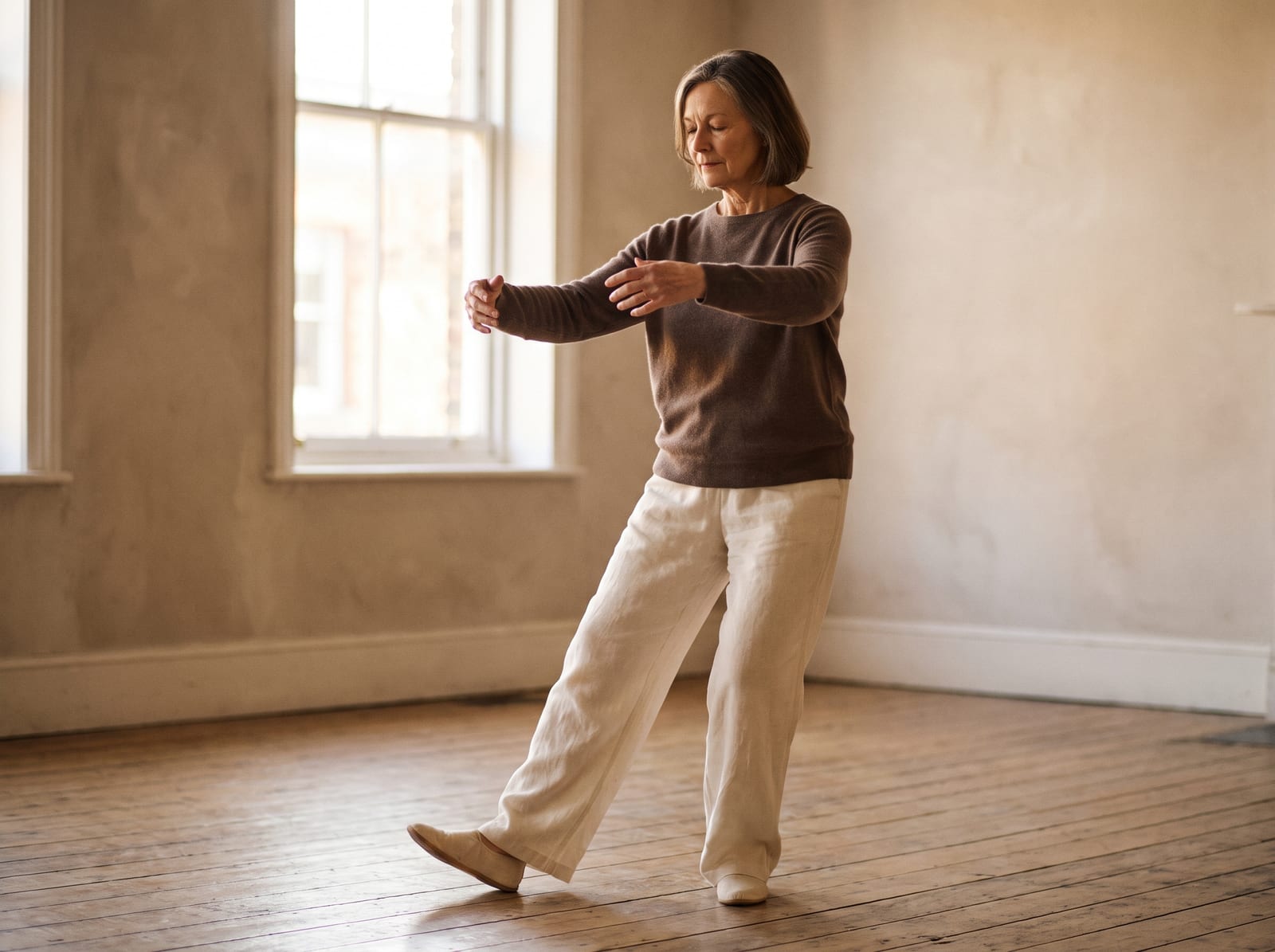
- Stand with your feet under your hips, knees soft rather than locked, weight even across both soles. Let your arms hang. Give it a slow minute before anything moves.
- Warm up with plain weight shifting. Move your weight fully onto the left foot, feel the right one go light without lifting it, then send it back the other way. Two or three minutes of that, unhurried, sets the pace for everything after it.
- Work through the movements at the speed the form asks for, which is slower than feels natural at first. The knees stay soft and tracking over the feet, the spine stays tall, and the arms move because the weight shift moved them rather than on their own.
- Breathe through your nose in your own rhythm and stop trying to match it to the movement. The forms that count breaths are a different practice from the one that was trialled.
- Keep going for the full forty minutes. That is the session length the trial ran, and a ten-minute version has never been tested against anything.
- Close standing still for a minute, weight even, before you go back to your day.
Dose: Forty minutes, three days a week, for sixteen weeks. The immune measurement in the trial came at the end of those four months, not after a fortnight, and the falls trial ran twenty-four weeks. This is a practice with a long runway.
⚠ This is educational content for discussion with a clinician, not medical advice or a prescription. Nothing here is a reason to delay or skip a vaccination, and no amount of tai chi substitutes for one. Standing practice on soft knees is demanding on the legs if you are not used to it, so work near a wall or a counter for the first weeks and sit down rather than push through dizziness. Ask your clinician first if you have had a recent fall, joint replacement, inner ear trouble, uncontrolled blood pressure, or anything that affects your balance or your feet. Stop for chest pain, breathlessness, or light-headedness. The trials behind this entry enrolled adults fifty-nine and over; what it does for anyone younger has not been studied.